
A bed is not one product, it is three layers with three different jobs: sheets manage skin contact and moisture, the duvet cover sets the surface feel and carries the laundry cycle, and the down comforter supplies insulation. Most people who are uncomfortable at night are running the wrong combination of layers rather than owning the wrong comforter.
That is useful news, because the layer that decides the most about how a bed feels is often not the one people replace first. Before buying a thinner comforter, it is worth knowing which layer is actually causing the problem.
Why the layers get confused
Bedding is sold as individual products but experienced as a stack. When a bed feels too warm, the instinct is to blame the comforter, because it is the biggest item. In practice the comforter controls one variable — how much still air is trapped above you — while its shell controls how heat and moisture actually leave the system.
That second half is where most beds go wrong. If moisture cannot get out, you feel hot regardless of how light the insulation is, which is why people who downgrade to a thinner comforter and still wake up damp have solved the wrong problem. A breathable linen down comforter is the clearest illustration of the difference: the same quantity of goose down behaves very differently depending on whether the fabric around it lets vapour through or holds it in. Insulation and breathability are two separate specifications, and only one of them is printed in large type.
Layer one: the sheets do the contact work
Sheets are in direct contact with skin all night, so they decide first impressions and they decide moisture. Fabric matters more here than anywhere else in the stack. Percale and linen feel cool and dry and get better with washing. Sateen feels smooth and slightly warmer. Bamboo-derived and TENCEL fabrics have a distinctly cool, fluid hand and move moisture quickly, which is why they dominate warm-weather recommendations.
The practical rule is to choose sheets for the sensation you want when you first get into bed, and to choose the fabric’s moisture behaviour for the middle of the night. Those are not always the same fabric, and where they conflict, the middle of the night should win.
One thing sheets cannot do: compensate for a comforter that is far too warm. They set the feel; they do not remove insulation.
Layer two: the duvet cover carries the routine
The duvet cover is the layer most people treat as decoration, and it is arguably the most functional item in the stack. It does three jobs at once. It protects the comforter from body oils and moisture, which is what lets a good down comforter keep its loft for years. It changes the surface texture of the bed without changing the insulation underneath. And it determines whether your laundry routine actually happens.
That last point deserves more weight than it gets. A cover you find awkward to put back on is a cover you will postpone washing, and a postponed cover means the comforter absorbs what it was supposed to be protected from. Corner ties, a full-length closure and a fabric that does not fight you are worth more in daily life than any particular thread count.
Owning two covers is the highest-return purchase in bedding. It turns stripping the bed from a project into a background task.
Layer three: the comforter sets the insulation
Only the comforter changes how much heat stays in. Everything else changes how it feels while it is happening.
Two approaches work. The first is one all-season down comforter with a breathable shell, used year-round, with the sheets and cover doing the seasonal adjustment. The second is two comforters — a genuinely light one for summer and a warmer one for winter — swapped twice a year.
The second approach is more comfortable in climates with real summers, and the summer half of the pair does not need to be complicated. The Warmy Tummy Summer-Breeze Down Comforter (Ultra-Light & All-Natural) is built for that narrow job: an ultra-light summer down comforter exists to give you the drape and the psychological comfort of sleeping under something, with as little trapped air as possible. That is a different design goal from the Light warmth level of a year-round comforter, which still has to function in October.
The specs, in plain terms
The all-season half of that pair is where the money should go, since it carries most of the year. On paper, the Warmy Tummy European Linen Goose Down Filled Comforter pairs a shell of 70% organic cotton and 30% linen at 500 thread count with a fill of 90% European white goose down from Germany at 700 fill power, held in a 3D baffle box with an extra warmth layer and anchored by corner loops, in Light, All Season and Ultra Warm across the three standard sizes — Twin/Twin XL 68″x86″, Full/Queen 90″x90″ and King/Cal King 107″x90″. Read that against the layer logic and the shell composition is the line the whole argument rests on, while the corner loops quietly matter more than they sound, because they hold the fill in place inside a cover and keep an even layer from going patchy. It carries OEKO-TEX® STANDARD 100 for the finished textile, Responsible Down Standard (RDS) for the sourcing chain behind the fill, and IDFL verification of the down and feather content — three different questions, answered by three different bodies.
Three configurations that work
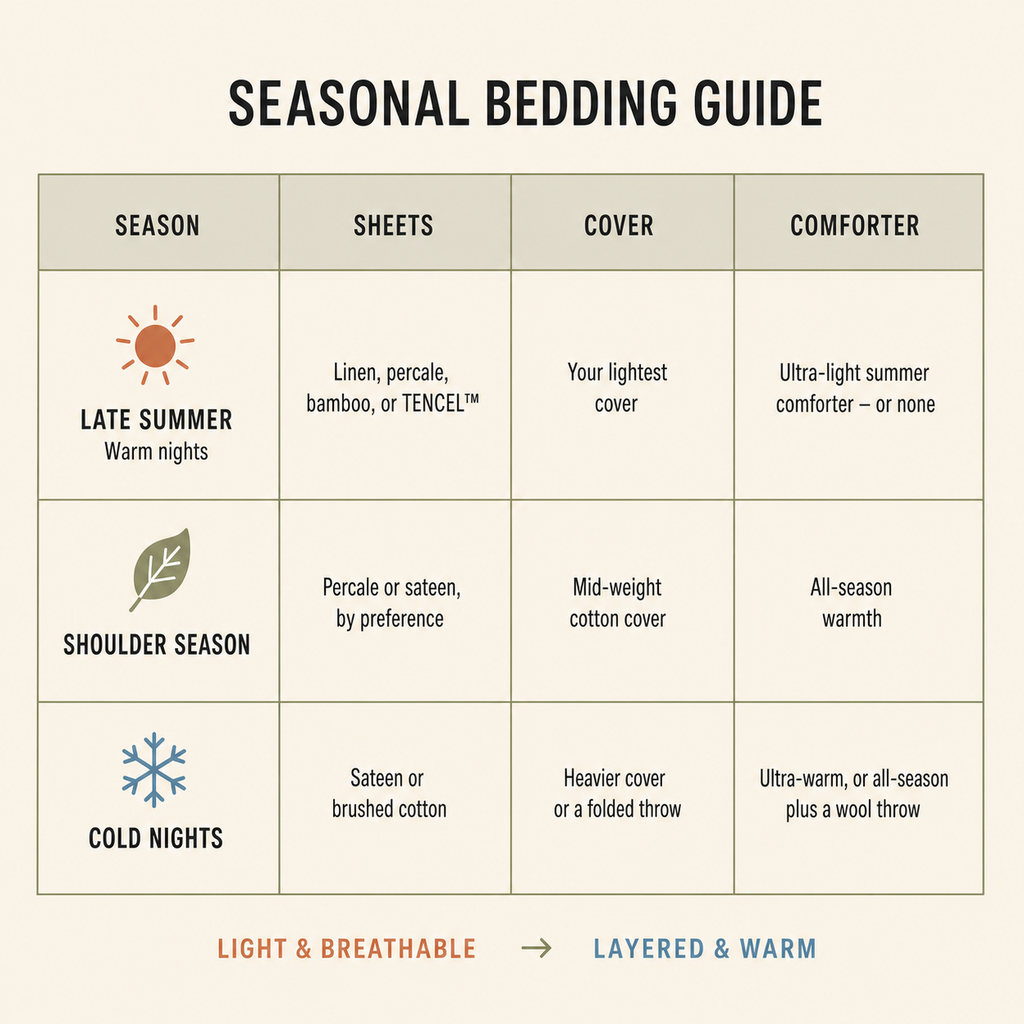
On warm late-summer nights, run a cool open weave — linen, percale, bamboo or TENCEL — under the lightest cover you own, with an ultra-light summer comforter or nothing at all on the worst nights. In shoulder season, move to percale or sateen by preference, a mid-weight cotton cover and an all-season warmth level. On cold nights, switch to sateen or brushed cotton, add a heavier cover or a throw folded at the foot, and go to the Ultra Warm level or keep the all-season comforter with a wool throw over it.
The shoulder-season setup is where most beds spend most of the year, and it is the one worth optimising first. The summer setup is where people get it wrong by half-measures: the Warmy Tummy Summer-Breeze Down Comforter (Ultra-Light & All-Natural) does a different job from an all-season comforter used with thinner sheets, and treating the two as interchangeable is why a lot of August beds feel almost right and never quite right.
What not to do
Do not stack insulation to solve a comfort problem. Adding a quilt on top of an all-season comforter because the bed feels wrong usually makes the moisture problem worse rather than better. Change the layer that touches you first.
Do not buy a cover you find annoying to handle, because you will not wash it, and the comforter underneath ends up absorbing what the cover was supposed to catch. When comparing signature duvet covers, the closure and the corner ties deserve more attention than the print does.
And do not assume a lighter comforter is always the cooler choice. A light comforter inside a dense, low-permeability shell can sleep warmer than a slightly loftier one in a breathable shell, because the constraint is airflow rather than thickness. It is the most common mistake in warm-weather bedding, and the reason a shell-first design like the Warmy Tummy European Linen Goose Down Filled Comforter is worth understanding as a type even if you buy something else: shell first, warmth level second.
FAQ
Yes, in practice. The cover protects the comforter from body oils and moisture, which is the main factor in how long a down comforter keeps its loft. It also lets you change the surface feel of the bed by season without buying a second comforter, and it is far easier to wash. Comforters are designed to be washed rarely; covers are designed to be washed often.
Change the two layers that touch you. Move to a cooler, more open sheet fabric such as linen, percale, bamboo or TENCEL, and switch to the lightest duvet cover you own. Then drop the comforter’s warmth level rather than its thickness. Ventilating the bedroom in the morning helps too, because it lets overnight moisture leave the bedding instead of being sealed in.
The one with the most breathable shell at the lowest warmth level you find comfortable. Shell fabric matters more than fill quantity for hot sleepers, because trapped moisture, not trapped air, is usually what wakes people at three in the morning. Linen blends and silk blends move vapour faster than dense cotton finishes. Choose the shell first, then the warmth level.