Ever glanced at a postage-stamp yard and wondered if you could still practice your short game without a full-size course? Maybe the kids play soccer on the lawn, or your HOA limits changes — but you still crave the satisfaction of sinking a 6-foot putt at home. If that sounds familiar, these backyard putting green small ideas will show you how to turn even the tiniest outdoor space into a functional, attractive, and low-maintenance putting area.
Why add a compact putting green to your yard?
Small putting greens deliver big benefits: they improve your golf game, add usable outdoor living space, and increase curb appeal. A mini putting green can be an eye-catching landscaping feature, a stress-relief spot after work, or a fun way to entertain friends. Best of all, you don’t need acres of land or a big budget — many of the ideas below are perfect for DIYers and first-time landscapers.
Planning your backyard putting green small ideas: what to consider
Before you dig, think about these essentials:
- Available space: A practice mat needs as little as 6′ x 3′, while a true putting green performs best at 10′ x 15′ or larger. Measure twice before committing.
- Purpose: Is this for practice, aesthetics, or both? Practice surfaces require more precise leveling and specific turf; decorative greens can be simpler.
- Drainage and slope: Good drainage prevents puddling; a gentle slope (1–3%) helps water run off.
- Sun and shade: Artificial turf handles shade better than natural grass; natural greens need 4–6 hours of sun daily.
- Budget: Portable mats cost under $100, while DIY artificial greens typically range from $500–$3,500 depending on size and materials.
Design inspiration for small backyard putting greens
Here are creative layouts that fit small yards and patios:
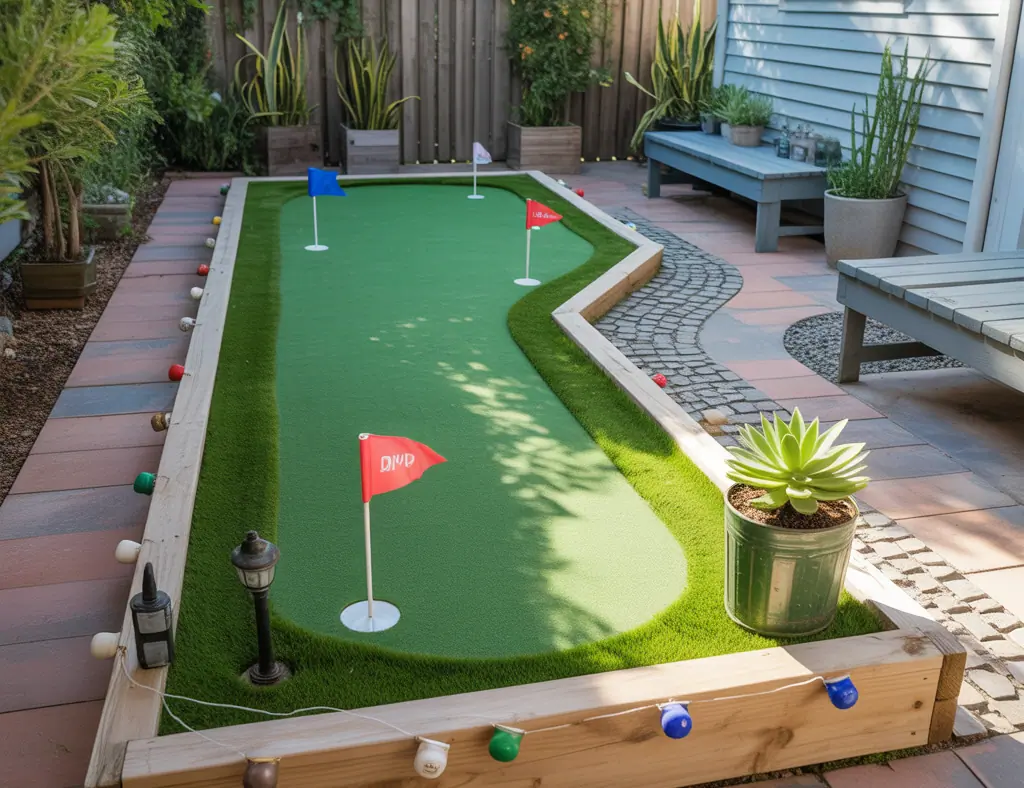
- Corner crescent: Tuck a curved green into a corner with stone edging and a low retaining wall.
- Linear practice strip: A narrow 6–8′ long strip along a fence makes a great short-game lane.
- Deck or patio insert: Replace a patio paver section with synthetic turf for a seamless transition.
- Raised planter green: Build a raised bed with turf on top — great for sloped yards and adds visual height.
- Portable roll-out mat: Ideal for renters or balconies; store it when not in use.
DIY step-by-step: install a small artificial putting green
This is a straightforward project for a weekend warrior. Tools and materials are listed first, followed by installation steps.
Materials and tools
- Artificial putting turf (golf-grade)
- Crushed stone or decomposed granite (base)
- Landscape fabric
- Plate compactor or hand tamper
- Seam tape and adhesive (if joining pieces)
- U-shaped landscape anchors or soda bottle cups for holes
- Shock pad or foam layer (optional for softer feel)
- Utility knife, rake, broom, measuring tape, level
Step 1 — Layout and mark
Outline your green with spray paint or string. Leave extra turf around edges for trimming. Decide where cups and slopes will be.
Step 2 — Excavate and base
Remove grass to a depth of 3–4 inches. Lay landscape fabric, then add 2–3 inches of crushed stone or decomposed granite. Compact the base until it’s firm and level — this is critical for a smooth putting surface.
Step 3 — Add shock pad (optional)
For a truer putting feel and added cushioning, install a thin shock pad over the compacted base. It also helps seat the turf evenly.
Step 4 — Lay the turf
Roll out the turf, let it acclimate, and trim the edges. If using multiple pieces, join seams carefully with seam tape and adhesive, ensuring the grain direction is consistent.
Step 5 — Install hole cups and finish edges
Cut holes slightly smaller than the cup for a snug fit and place cups built for practice greens or repurposed safety bottles. Secure turf edges with landscape anchors, pavers, or decorative edging.
Step 6 — Brush and test
Brush the turf fibers upright with a stiff broom. Test putts and adjust slopes or compaction if necessary. Minor imperfections can often be corrected by adding or removing base material under the turf.
Low-cost and temporary options
Not ready for full installation? Try these quick ideas:
- Portable putting mats — great for indoors, decks, and small patios.
- Roll-out turf with temporary adhesive — useful for events or seasonal installation.
- Put your mat on a level paver pad or patio slab for instant stability.
Maintenance and care tips
- For artificial turf: sweep debris weekly and rinse occasionally. Remove leaves and pet waste promptly.
- For natural turf: mow to a shorter length and water deep, less frequently. Consider a specialty bentgrass blend for true roll (but know it’s higher maintenance).
- Check seams and edges annually and top up base material if you feel divots or soft spots.
- Use a dedicated putter and softer golf balls for turf longevity.
Real-world advice from DIYers
Many homeowners report the biggest challenge is a poorly compacted base — an uneven base ruins roll quality. Spend extra time compacting and checking levels before laying turf. Also, test different hole placements to keep practice interesting: a 10′ distance with a slight break is a great daily drill.
When to hire a pro
If you’re building multi-level greens, adding bunkers, or want professional-grade roll with undulating breaks, hiring a landscape contractor with putting-green experience can save time and prevent costly mistakes. For budget-friendly results and simpler layouts, DIY is totally achievable.
Frequently Asked Questions
How much does a small backyard putting green cost?
Costs vary: a simple portable mat can be under $100, a DIY artificial green for a small area typically runs $500–$3,500 depending on materials and size. Professional installations start higher due to grading and custom shaping.
Can I use artificial turf for a realistic putting surface?
Yes — golf-grade synthetic turf designed for putting can mimic real roll when installed over a properly compacted base and, optionally, a thin shock pad. Selection of turf pile height and backing quality matters for true performance.
Do I need special drainage for a small green?
Good base preparation usually provides sufficient drainage. Use crushed stone or decomposed granite and compact it well. If your yard has heavy clay or frequent standing water, consider adding a drainage aggregate or consulting a pro.
Conclusion — Ready to try backyard putting green small ideas?
Whether you choose a portable practice mat or build a custom mini green, these backyard putting green small ideas prove that a limited space doesn’t limit your short-game practice. Start with a clear plan, focus on a stable base, and pick materials that match your budget and maintenance comfort. Ready to make a weekend project out of it? Check out more DIY projects and home design ideas to inspire complementary landscaping — or, if you’re remodeling indoors too, see our kitchen upgrades guide for project-planning tips. Share your plans below or ask a question — I’d love to help you design a small putting green that fits your space and style.